You might have thought that studying the impacts of artificial intelligence is only for researchers in computer science and physics. Not so fast: Thanks to a sizable grant from the National Endowment for the Humanities (NEH), the College of Letters & Science launched the Center for Humanistic Inquiry into AI and Uncertainty late last year. The Center recently unveiled its first set of fellowship grants to L&S faculty researchers in the humanities and social sciences. They’re tackling some seriously thorny questions about the ways in which AI is altering our world.

The Write Way
Much of what we think of as artificial intelligence are based on large language models (LLMs), systems trained on massive datasets that generate the answers to the queries you put into chatbots. Ainehi Edoro-Glines, the Constellations Mellon-Morgridge and Vilas Early Career Professor of English, is tackling a question that’s currently flummoxing the humanities: What does the automation of writing mean for disciplines built on the written word? To find out, she and a team of students are constructing a laboratory to study how students are using LLMs and how that changes their perception of writing.

The Limit Does Exist
Devin Kennedy, an assistant professor of history and the Evelyn and Herbert Howe-Bascom Professor of Integrated Liberal Studies, has spent his career charting the history of computer science. He’s now focused on exploring the theory of computing, a subfield of computer science that looks at the basic algorithms computers use and what their ultimate limits might be. “I’m trying to write the history of a very technical subject,” says Kennedy. “That requires lots of time and patience to learn, get stuck and ask questions until you understand the language of researchers, their ideas and the issues that motivate them.”

New Norms
Anja Wanner was already researching her new book project, Bad Grammar in the Digital Age, when the Center launched last year, and the consonance was perfect. Wanner, the Enid H. Anderson Professor of English, is looking at how our view of what it means to understand language is challenged by digital platforms and AI. As AI makes linguistic performance more accessible while divorcing it from human identity and intent, what does that mean for linguistic experts? “Has the text that you are reading right now been produced by me, or did I copy and paste a suggestion from ChatGPT?” Wanner asks. “Would the latter violate any professional norms? Would I still be the author if my role is only to write prompts? Does it even matter?”
Shaping Sense of Self
Catalina Toma, an H.I. Romnes Faculty Fellow and professor of communication arts, studies how technologically mediated interactions affect human self-concepts and relationships. As teenagers increasingly turn to conversational AI to work through complex emotional, relationship and identity issues, Toma is seeking to expand the debate beyond the familiar binary of AI as either a productivity tool or a social threat. “Unlike peers or parents, AI systems draw on vast datasets of human communication, respond without fatigue or judgment, and often mirror or amplify users’ emotions and self-descriptions,” says Toma. “If adolescents are internalizing AI-generated feedback as insights about who they are, then AI is becoming an epistemic actor in the development of self-knowledge.”

More to Come
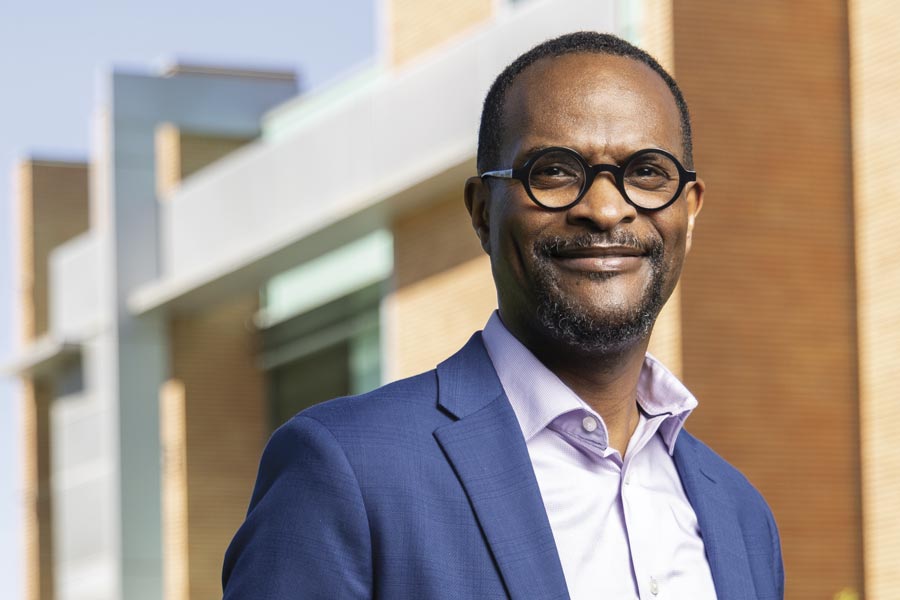
While the initial round of fellowships only included some of the College’s humanities and social science departments, there’s much more to come in future funding cycles. Jeremy Morris, a professor of communication arts who serves as the Center’s inaugural director, anticipates future project proposals from faculty in departments like journalism and mass communication, gender and women’s studies, philosophy and more. “Hopefully, what we’re building here is a robust network of people who are approaching AI from humanities and social scientific perspectives, who can be thought leaders,” he says. “AI’s biggest impacts are not going to be technical; they’re going to be cultural.”