
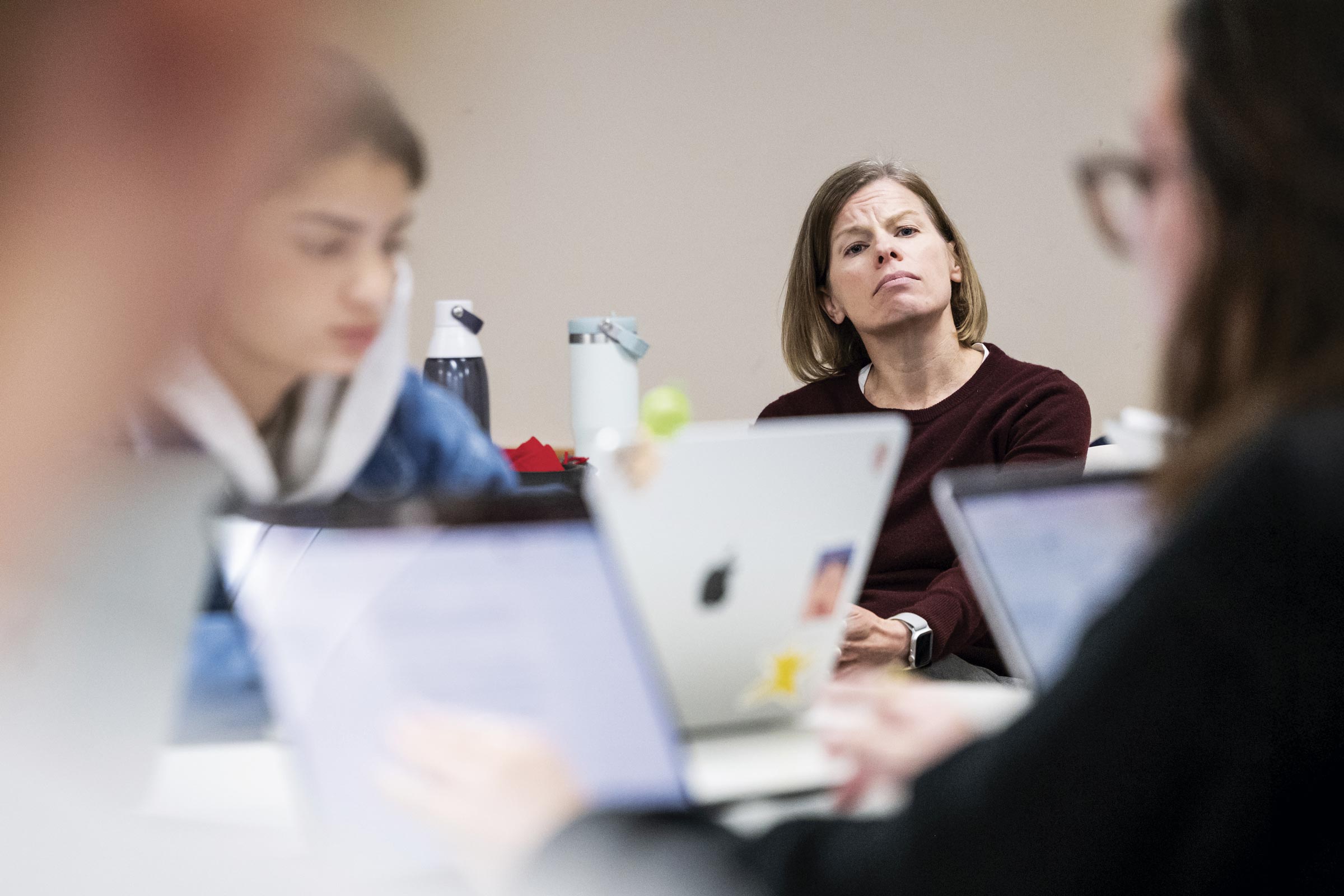
The experience begins, not with arguments and controversy, but with storytelling.
The 30 assembled students are paired off, and each is asked to share a story with their partner about a time when they changed their mind about a political issue. Later, they’re asked to reshare the story they were told to the class, speaking as the partner who relayed it to them.
That’s the launching pad for “Advancing Public Policy in a Divided America,” a class that serves as the foundational requirement for a brand-new undergraduate degree program in public policy beginning in the fall at the La Follette School of Public Affairs. And as Amber Wichowsky, the associate professor hired to teach it explains, the strategy is intentional.
“This approach does a couple of things,” says Wichowsky, whose background in political science includes a focus on political behavior and the creation of a civic dialogue curriculum at Marquette University. “First, it gets students in the habit of deep listening, which is the ability to sit with somebody and just listen to them for several minutes. And hopefully, they’re also learning a little bit about each other. Where are people coming from?”
Those skills seem to be in painfully short supply in the modern political environment — and just about everywhere else. Deeply polarized points of view have made it extremely challenging for people to talk to each other, let alone work together to solve important social and political issues.
On a particular issue, you might actually have some common ground. But the only way you’re going to know that is if you’re talking to people and having that kind of social connection.
For Wichowsky, her first goal is to create a safe but talkative environment, where students learn about the roots of our country’s current division, the science of how we develop our political opinions, and how that understanding can be used to have more civil and open conversations about contentious issues. Students are also introduced to nonpartisan policy research methods and spend time evaluating policy arguments and evidence. In the course’s final unit, students practice negotiation skills in a role-play exercise.
It’s not always easy. In last year’s class session, students worked through differing perspectives, experiences and stereotypes as they deliberated different approaches to policing reform. Wichowsky notes that such conversations can be uncomfortable, but that students in the class come away seeing the value of engaging across differences and more confident about their own civic skills.
“I tell students that if you want to break through this impasse, you have to think about coalitions and coalition building,” says Wichowsky. “On a particular issue, you might actually have some common ground. But the only way you’re going to know that is if you’re talking to people and having that kind of social connection. If you’re in the echo chamber, you’re blind to those possibilities.”
Just as it began, Wichowsky’s class ends with a story exchange. Her students now know each other better and are more open to being vulnerable. And maybe, just maybe, are more open to understanding another’s viewpoint.