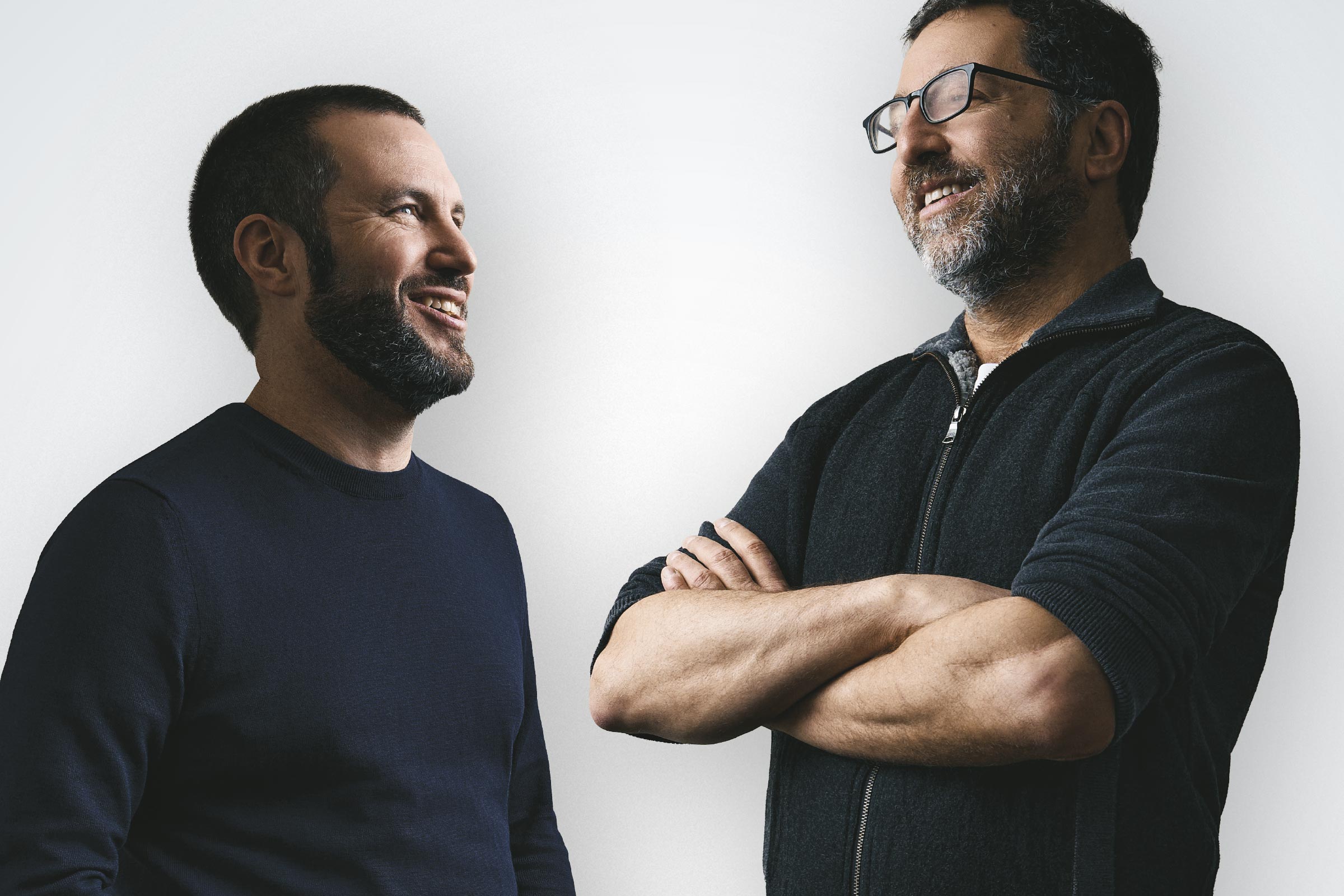
Uncertainty is an essential part of the human condition. We all struggle with it. It’s also the central concept of books currently being written by not one, but two College of Letters & Science faculty members: Don’t Be Too Sure by Jordan Ellenberg from the Department of Mathematics and Think Better by Michael Titelbaum from the Department of Philosophy. To take advantage of this cosmic coincidence, we put them in a room together and watched the existential fireworks ensue.
Michael Titelbaum (Vilas Distinguished Achievement Professor of Philosophy): People are not very good about reasoning with uncertainty. They are modestly good at thinking in all-or-nothing, black-or-white categories, but a lot of things we have to figure out and decisions we have to make in life are more gray than that. There are decades of research showing when people try to think in cases that involve a lot of uncertainty, they make a lot of mistakes. The hope is to give people some guideposts and some straightforward lessons to help them think better in cases of uncertainty.
Jordan Ellenberg (John D. MacArthur and Vilas Distinguished Achievement Professor of Mathematics): There is a stereotype that what people might come to a mathematician for is certainty. For example, “Compute for me: If I do A, what is the consequence B?” People really crave that for deep-seated psychological reasons. My book is slightly cruel in that you’ve come to me and I’m going to pull the rug out from under you and say, “No, you can’t ask for that. That’s not the way the world is.”
The world is made of uncertainty, but then, to hopefully soften that blow, there are lots of rather rigorous and well-thought-through ways of thinking about uncertainty. Rather than pushing it away — a natural impulse — you can instead engage with the world as it is. And then the good news is that the discipline of mathematics doesn’t just give up and not talk about things if they’re uncertain.
This is one way we’re in agreement. It’s not the case that every kind of uncertainty is well modeled by a number between zero or one.
MT: Did you watch the “Golden Globes” this year? Before each award was announced, they would share what the current probabilities of victory were, according to Polymarket’s prediction models. The odds were literally just an aggregation of people’s opinions, because there is no data history you can look back on for how often Leonardo DiCaprio is going to win best actor in a musical or comedy.
That’s the world we’re in now, where everybody thinks of everything as quantifiable, and they think that the rational way to proceed with any decision you could ever try to make is to compile these numbers and then let the numbers run your decision-making. So, one of the other things I’m going to talk about in my book is: What sort of decisions doesn’t it make sense to attach probabilities to?
JE: This is one way we’re in agreement. It’s not the case that every kind of uncertainty is well modeled by a number between zero or one.
MT: There are two different questions you can ask. One is: Is it well modeled by a number? A different question you can ask is: Of the ways we have available to model it, is this the best one? And there are people who think that the best thing we’ve got going is a number between zero and one, and so that’s the way we should make our decisions.
You come from a discipline where everyone looks to you mathematicians for answers, as if you’re going to have these authoritative answers. I come from a discipline where students walk into a philosophy class assuming there are no right answers.
JE: It would be too much for me to say I want to eliminate people feeling uncomfortable with uncertainty. I think we’re human beings, and that’s part of human nature. It’s funny: I just read a book by Pema Chödrön called Comfortable with Uncertainty. It’s a great book, but come on, nobody’s that chill.
MT: Well, uncertainty is tied to anxiety, right? It’s also built into a lot of the ways we talk about the world. We have a lot of concepts where something is safe or it’s unsafe. Something’s a good bet or it’s a bad bet. One of the things that I try to do to help people get a little more comfortable with uncertainty is to point out that we also have ways of talking about the world that are more comfortable being in the middle.
Jordan, it’s so funny because you come from a discipline where everyone looks to you mathematicians for answers, as if you’re going to have these authoritative answers. I come from a discipline where students walk into a philosophy class assuming there are no right answers. So, the idea that you can make progress at all on these questions, and that there are some things all philosophers agree on, is very strange and surprising to them.
JE: There’s this sort of tension. Mathematicians have developed these probability tools that can really help you out of some bad spots and get you to a better way of thinking. But when it goes too far, you start ruining the “Golden Globes,” for crying out loud.