

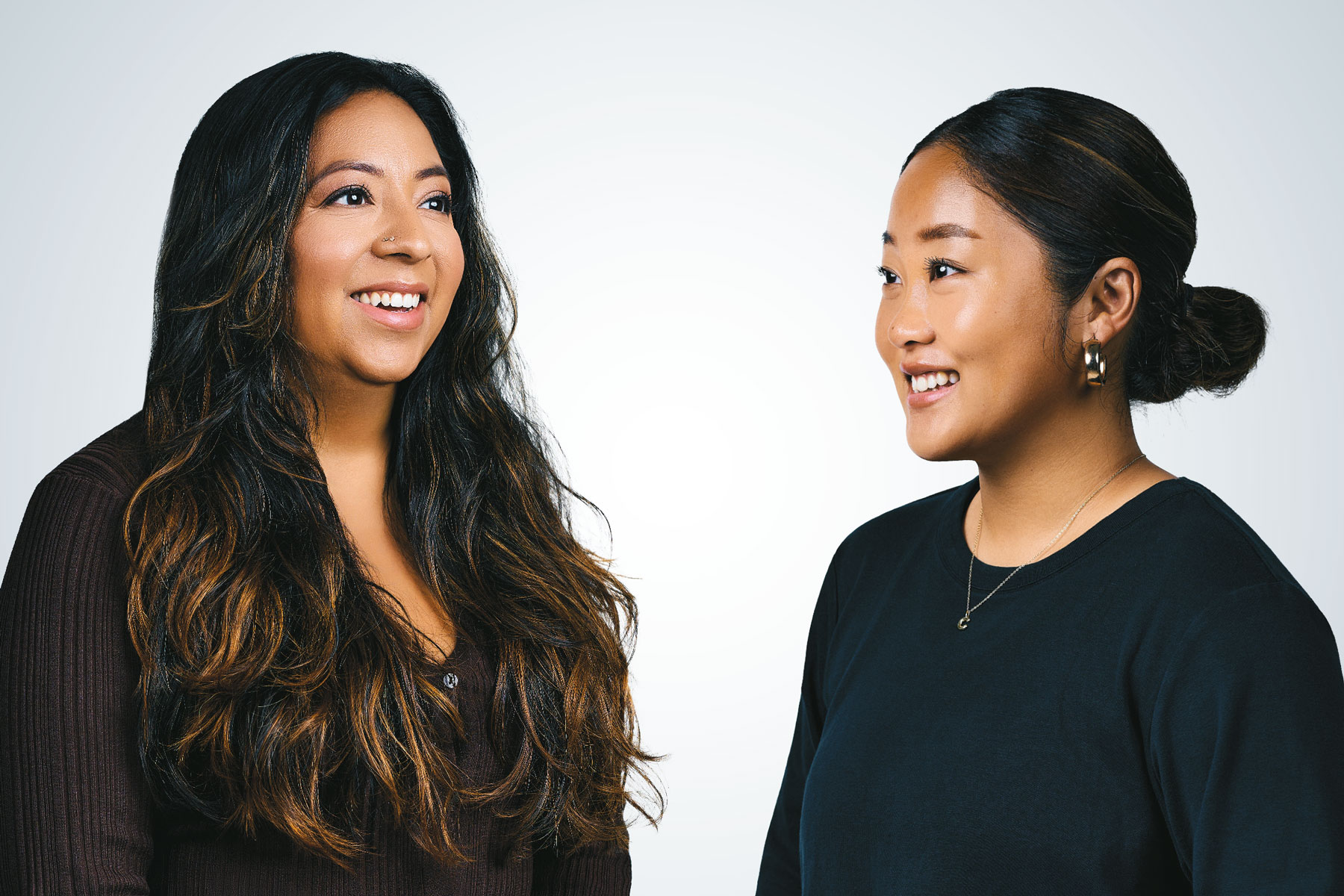
Sixty years ago, the Center for Academic Excellence (CAE) launched with a mission to help first-generation, low-income and rural students connect and succeed at UW–Madison. The program has gone by different names — the Five-Year Program and the Academic Advancement Program — but the life-changing formula of support and encouragement has remained the same. We sat down in CAE’s current space on campus with alumna Miriah Albouras (’12), who’s now a mother and academic advisor in higher education, and Emily Vang, a junior studying political science, to hear about their experiences.
Miriah Albouras (alumna): I became involved in CAE and the Academic Advancement Program (AAP) as a freshman. I still, to this day, remember my CAE advisor, Linda McCarroll Stamm. She was a big influence in my small life at that time and even beyond that experience. She’s who got me interested in advising.
Emily Vang (current student): For the past three years of being a CAE scholar, I have been a peer mentor, which is kind of like being an older brother or sister figure for the incoming freshmen class. My first year, I had a peer mentor, too. It was nice to have a peer to talk to and be there to help and slowly transition me into college. If it were not for CAE, I don’t think I would have created and obtained as many opportunities as I did, and that’s in part thanks to my CAE advisor, Hernan Rodriguez (’23, MS’25). I’m always in his office, always asking questions. I like to joke that he should be tired of me at this point!
I’m continuously surrounded by a community that’s always looking out for me, always wanting the best for me, always supporting me in everything that I do.
MA: I feel you on the always in the office thing. It was almost like I was a shark: OK, let me see if their door is open so I can ask, “Do you have a moment?” And Linda would always find time for me, and so I’d go in there, crying or talking about what was going on with me.
EV: Yes, me, too! I always thought that it was so embarrassing to sit there and basically pour my entire life story out there, but it’s just so helpful. It helped that Hernan had the same major as me, to be able to talk to somebody who went through exactly what I went through. As a first-gen student and as somebody that doesn’t often see themselves in my specific major, it can be hard to try and navigate it all by myself.
MA: I became pregnant with my daughter my freshman year, and I had to ask, “How am I going to do all of this?” I was really scared. But once I told Linda here at CAE, she said, “No problem, we’ll figure it out.” That really kept me in college — I needed that support and motivation.
I probably had some of the biggest life decisions and experiences during college. But that is the time to take those risks, tackle those challenges and go outside of your comfort zone, because if you do fall or fail or struggle, you have CAE to come back to.
EV: It’s interesting to see how much support I get from CAE. I’m continuously surrounded by a community that’s always looking out for me, always wanting the best for me, always supporting me in everything that I do.
MA: I’m 37, and my daughter is turning 17 and thinking about college — talk about your full-circle moments — and now that I look back at those four years of college, I think about how quickly it goes. I probably had some of the biggest life decisions and experiences during college. But that is the time to take those risks, tackle those challenges and go outside of your comfort zone, because if you do fall or fail or struggle, you have CAE to come back to. Once you’re out of college and you’re in the workplace, it’s very different.
EV: The big thing that we tell our new students in CAE is that you get what you put into it. You can’t expect to have a bunch of friends and all these opportunities if you don’t put yourself out there. That’s what I would tell my younger self, at least, is you have to put yourself out there. You’re starting off on a brand-new foot. You have nothing to lose. But I think when you already have a community here, or when you establish one, it’s easier to think, “It’s OK, I am not alone.” That’s the biggest factor in it all.