


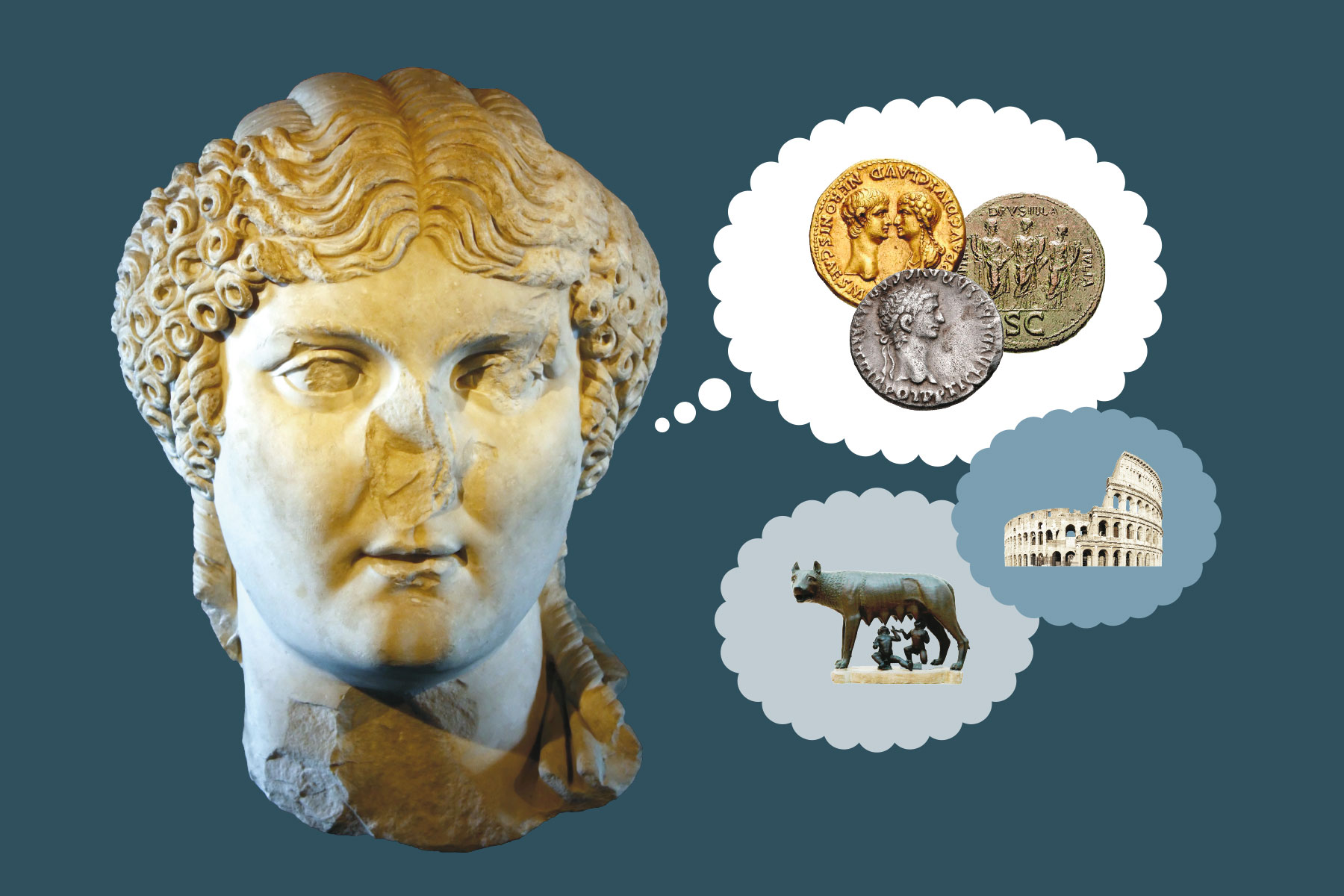
A few years back, vast swaths of the social media universe were captivated by a straightforward but random question women were asking the men in their lives: How often do you think about the Roman Empire?
For the last several years, Rachel Andrews (MA’23) has had her own answer: Basically, every single day.
Andrews, a PhD candidate in the Department of Classical and Ancient Near Eastern Studies (CANES), found her Roman-centric research calling while working a summer internship at the Chazen Museum of Art. While cataloguing the Chazen’s extensive collection of ancient Roman coinage, Andrews noticed something surprising — there were a lot of women on the coins.
“Seeing the emperors, and seeing lots of them at one time, I started to think about how they would feel when they saw women on coins,” Andrews says. “What would this mean to someone who was handling them?”
Unlike the United States, the Roman Empire regularly featured powerful and important women on its currency. By the time Marcus Aurelius became emperor in 161 A.D., one in every three Roman coins featured a woman. Outside of dollar coins briefly minted to honor Susan B. Anthony and Sacagawea, the United States has rarely featured a woman on its regularly issued coinage.
They’ve been called monuments in miniature, something that would allow a Roman citizen to bring the messaging of the Empire into the home or into their own pockets.
One of the most ubiquitous women featured on Roman coins is Agrippina the Younger, the ruthless and ultra-connected great-granddaughter of the first Roman emperor (Augustus), sister of another emperor (Caligula) and wife to a third (Claudius). Her visage adorns a variety of gold and bronze coins, and she’s the first woman to have her face on a coin during her own lifetime.
“She had trifold power that all linked back to that first emperor, which was really important in the Roman mindset,” says Andrews. “She had positioned herself as an essential figure in the transfer of imperial power during the final years of the Julio-Claudian era.”
Like many nations, Rome was concerned with reflecting its values on its currency — in this case, the idea that women were essential to the peaceful transfer of power within the empire. When paired with the images that appear on the reverse sides of the coins that feature Agrippina, her coins also speak to the woman’s role in propagation and fecundity.
Andrews notes that eventually, Agrippina’s image began to take on masculine qualities, embracing the more traditional male vision of power. It also began to be associated with popular Roman figures, first with the Roman general Germanicus and later alongside the Emperor Nero, Agrippina’s son. Her visage appeared on at least three imperial coin types.
Compare that to the United States, a country that didn’t place a president on a coin until 1909.
“I would say that there’s a reason why the earliest American coins don’t have our leaders on them, and there’s folklore that George Washington was asked to be on a coin and said no,” says Andrews. “There’s a sort of caution: You had American colonists with King George bopping around in their pocket, and Washington didn’t want his image to be alongside that sort of monarch.”
Andrews is also studying coins that featured other female Roman rulers, including Julia Domna, the first empress of the Severan dynasty. Domna’s coins echo those of Agrippina, in that they push her image as a figure of power. That’s a theme that also extends to the Byzantine Empire, where the Empress Irene of Athens, who blinded her own son to consolidate her power, eventually upended social norms by having her image on both sides of a coin instead of only one.
“The Romans did not like having a leader’s image on two sides of a coin,” says Andrews. “It’s a power move, and the messaging cannot really be overstated.”
Given that the Julio-Claudians had 900 different types of coins minted during their nearly 100-year reign, Andrews has much more to dig into as she completes her graduate work. This includes investigating the reactions of the Romans who used the coins in daily life and re-examining the stories of the women who appeared on them through non-traditional sources. That’s a lot of history to distill from small circular pieces of gold, silver and bronze.
“Although they were small, these coins were definitely mighty messengers for the Roman Empire,” says Andrews. “They’ve been called monuments in miniature, something that would allow a Roman citizen to bring the messaging of the Empire into the home or into their own pockets.”