
While most people remember their first foraging experience for the fungi, Laura Oberwetter (’18) remembers the smell. When the tell-tale scents of spring blow in the breeze, she’s taken back to that time when she was eight years old and was warned, “These aren’t normal mushrooms.” For young Oberwetter, who’d never even had a so-called “normal” mushroom before, the disclaimer was wholly unnecessary: The fleshy brown barnacles being offered looked like something from the deep seafloor, if not the moon.
In fact, they were Morchella esculenta, commonly known as morels, foraged by her friend’s dad from a forest near their homes in Middleton. By accepting them — initially out of politeness and then with enthusiasm — Oberwetter was inducted into the Midwest’s mushroom foraging tradition, long observed in the quiet, greening woods across Wisconsin.
For the rest of her adolescence, spring meant mushroom hunting underneath the canopies of mixed and broadleaf forests, until the smell of wood violets and decaying leaf litter conjured a Pavlovian response in her brain. Little did she know at the time that she would someday bottle it up to share with the world.
Fragrance Family
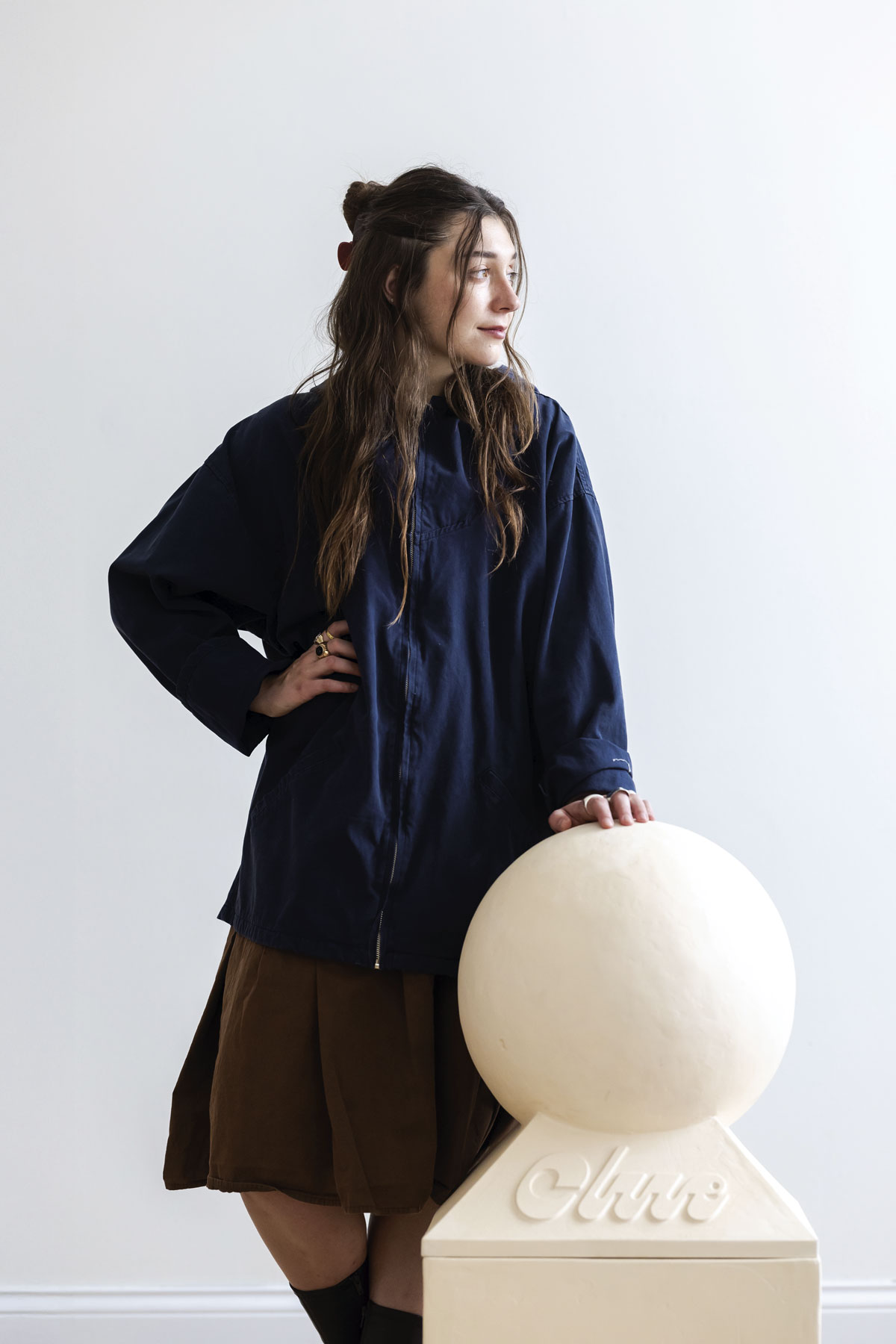
A couple decades later, and a few years after graduating from UW–Madison with a degree in communication arts and moving to Chicago, Oberwetter co-launched Clue Perfumery, an indie fragrance house, alongside high school friend Caleb Vanden Boom. Both grew up among morel foragers, so when the brand quietly introduced itself with just three experimental scents in November 2023, there was no question that Morel Map — a “damp, green, loamy” forest floor — must be one of them.
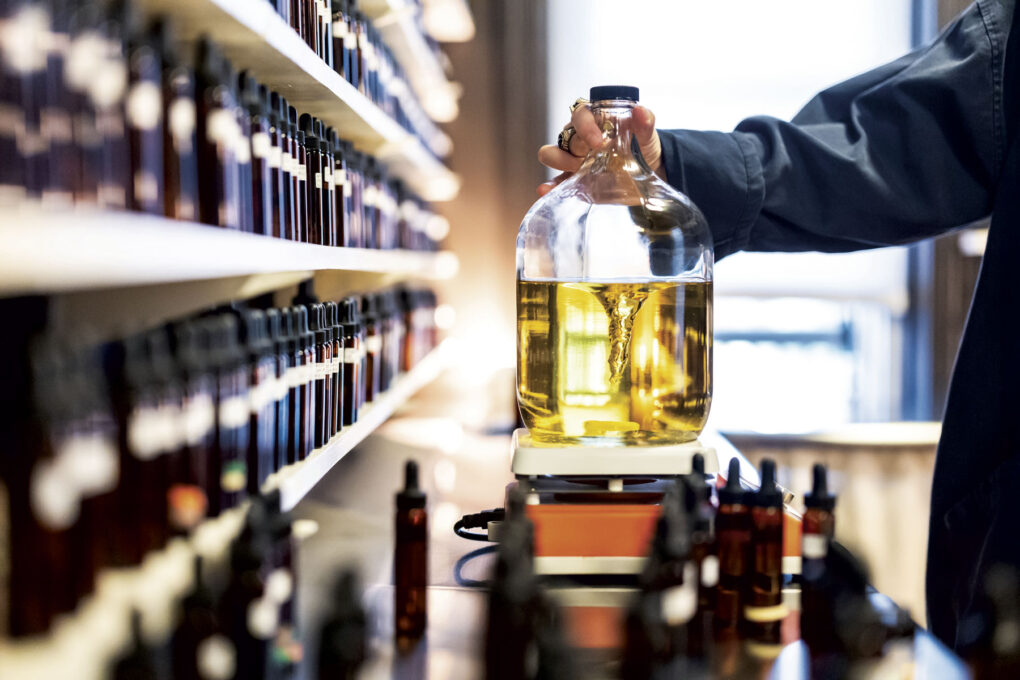
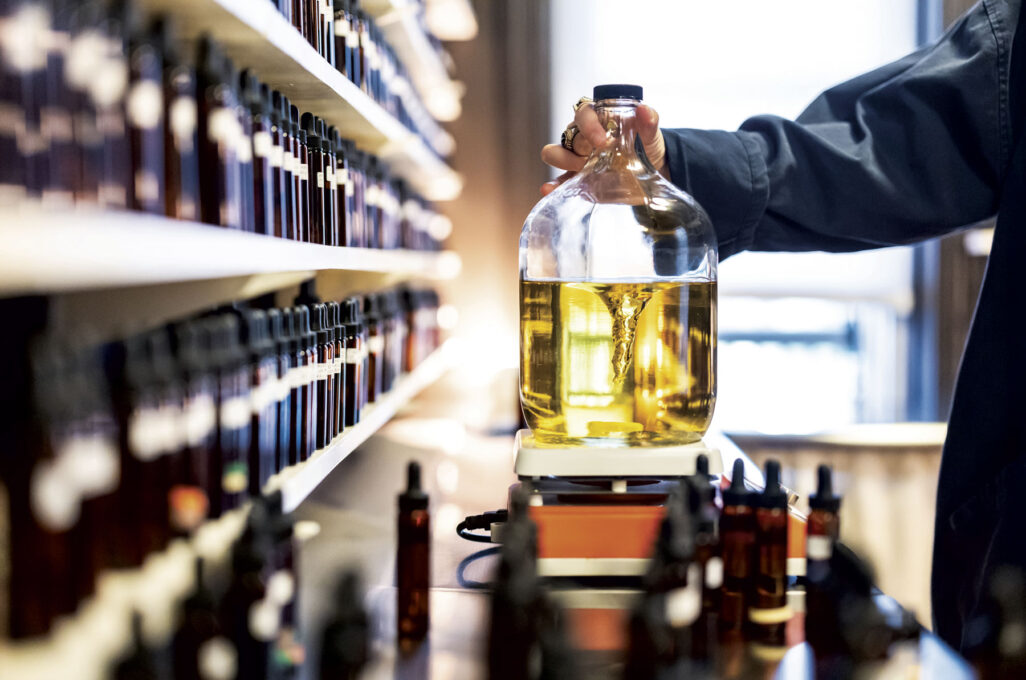
“Caleb and I have a lot of the same creative reference points,” says Oberwetter, Clue’s “nose,” or lead perfumer. Each scent begins with her at the organ, an industry term for the perfumer’s workbench that stores raw materials like essential oils, resinoids, synthetic aroma molecules, aldehydes and more.
“It’s called the organ because they’re all ‘notes,’” she says, referring to the hundreds of glass vials organized in amphitheater shelving.
I just refused to believe that it was impossible to get into, even though that’s what everyone was saying.
In Clue’s fragrance lab, these essences are densely layered until Oberwetter feels she has achieved something “truthful,” a process that can require anywhere from 25 to 60 different notes working in concert.
“A really fun part of the formulation process for me is when we finally have something that smells good,” she says. “What can we add to make it smell real?”
Day to day, this is what she’s working on, tinkering away with alchemical-looking apparatus in the backrooms of Clue’s brand-new Logan Square storefront. With the shop (hopefully) opening this year, it will fully bring Oberwetter’s fragrances to life, all the way down to the floor plan: Viewed from above, the store’s layout will mimic the signature skeleton keyhole silhouette of Clue’s perfume bottles. The shape draws you further into the space as it tapers back, with stops along the way at displays introducing the fragrances as individuals.
Heart Notes
Clue’s visual world building is primarily Vanden Boom’s purview. He’s an independently successful graphic designer who’s worked with pop culture darlings like Clairo, Apple TV’s “Severance” and others. He develops unique visual expressions for each fragrance, pushing back against the homogeneous marketing treatment — Slow-motion running! Untouched wilderness! Woman on a horse! — that most mass-market perfumes end up with.
“So much in the fragrance space is about the exotic, traveling to remote places and experiencing things outside yourself,” he says. “We’re interested in exploring our own mythology.”
Immersive, thematic and ultra-specific, each of Clue’s five fragrances — Morel Map, The Point, With the Candlestick, Warm Bulb and Dandelion Butter — comes to you as an uncanny reminder of what Vanden Boom calls a “shared place of memory.” You’ve probably already smelled The Point, ocean waves crashing against sand in late summer, and Dandelion Butter, too, their sap-filled stems crushed against cracks in hot concrete. They’re simple pleasures, entire biomes, distilled into a 30 mL bottle.
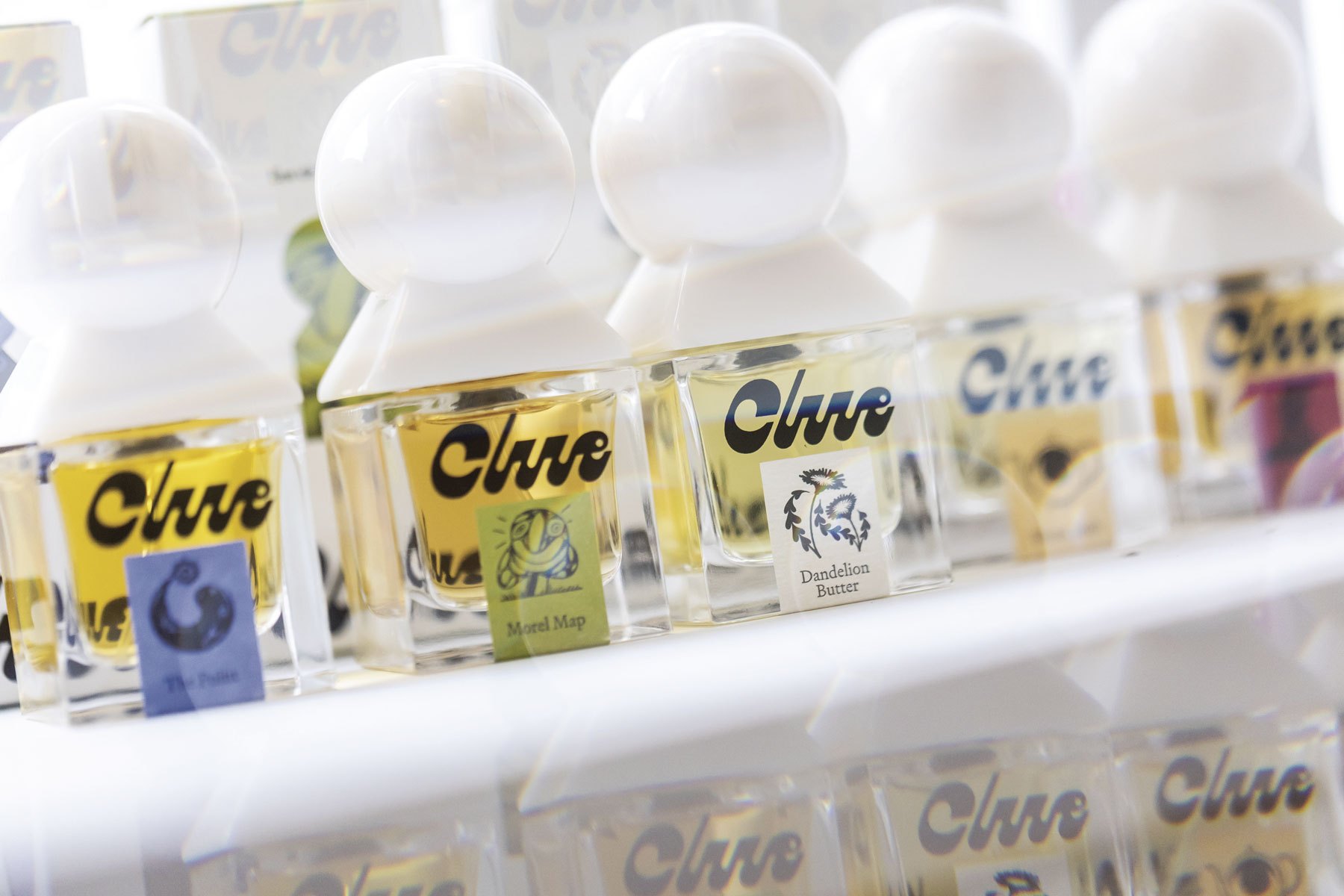
Since launching, that fastidious attention to detail has enabled Clue to succeed in a way that might almost seem, but definitely isn’t, effortless. Already, their perfumes have been accepted and embraced by the real authorities: the “niche fragrance heads” holding forth on forums like Basenotes, Fragrantica and r/indieperfume. In 2024, Warm Bulb was named an artisan finalist for the Art and Olfaction Awards, and, in 2026, Dandelion Butter was named the people’s choice in the artisan category.
And in early summer of 2026, another auspice: Actress and singer Zendaya was photographed perusing Clue’s fragrances at Stéle, a cult-favorite artisanal perfume boutique in New York City.
It’s worth noting that this has all been achieved without even a hint of outside investment or paid marketing. And in Oberwetter’s case, without the years-long formal training most perfumers undergo.
“I just refused to believe that it was impossible to get into, even though that’s what everyone was saying,” she says.
Accord
As it happens, there are no perfume schools in the U.S. A traditional path to perfumery would be to get a bachelor’s degree in chemistry, save up another $50,000, then apply for a spot at a notoriously competitive French or Swiss perfumery school. After that, land an apprenticeship at one of the top four food and fragrance houses dominating the global industry. Then, after a few more years of benchwork, and assuming the master perfumer you’re studying under recommends you for it, you might finally call yourself a perfumer.
Against this, Oberwetter’s path — a degree in communication arts and two certificates in business and entrepreneurship — was unusual. Just don’t call it a disadvantage.
“Would it have been better for me to study chemistry?” she asks. “Maybe, but I think the media and art criticism skills I learned in communication arts are better for the work.”
In lieu of training in Europe, Oberwetter spent years buying perfume samples, studying and writing about them as an amateur, collecting her notes in a spreadsheet and haunting the same forums that would later praise her work as a perfumer. When the pandemic hit, she took remote classes from The Institute for Art and Olfaction in Los Angeles, thus cobbling together whatever instruction she could find.
“We’re obsessed with folk art and the against-all-odds beauty of places like the Midwestern grottoes, where somebody had a vision, regardless of their skill,” she says. “That does feel like it’s home for me. Because I’m naive, and I don’t know what I’m doing.”
By this, she means she’s following her creative instincts, allowing herself to be drawn again and again to the “weird wonder” of Wisconsin without being waylaid by market research. “We’ll never make ‘sexy beach,’” Oberwetter promises. “What we know is Cave of the Mounds.”