

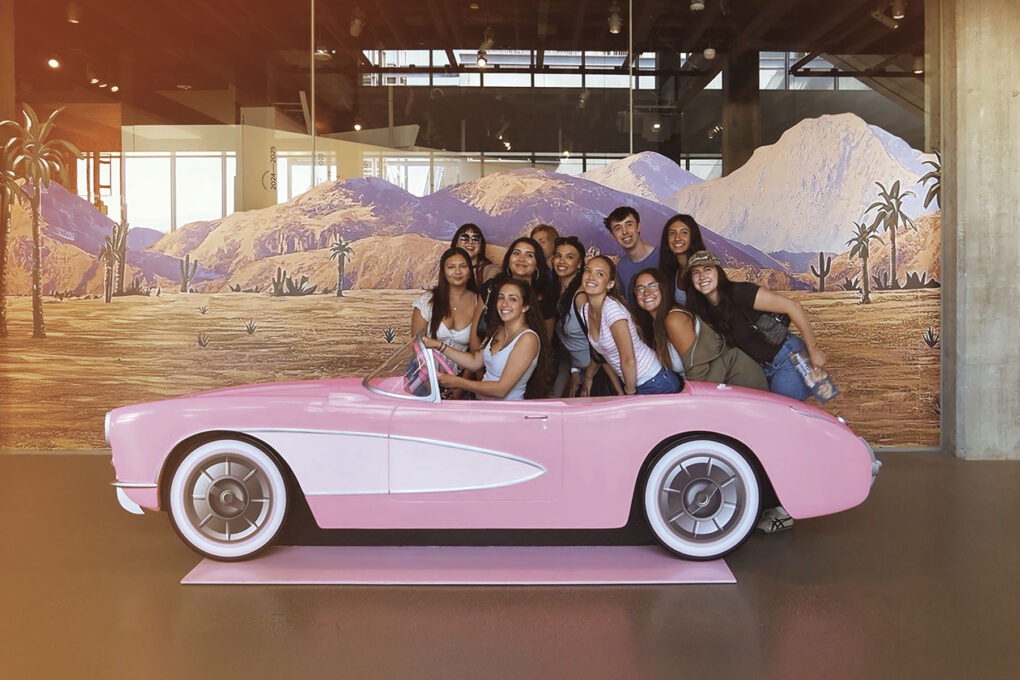
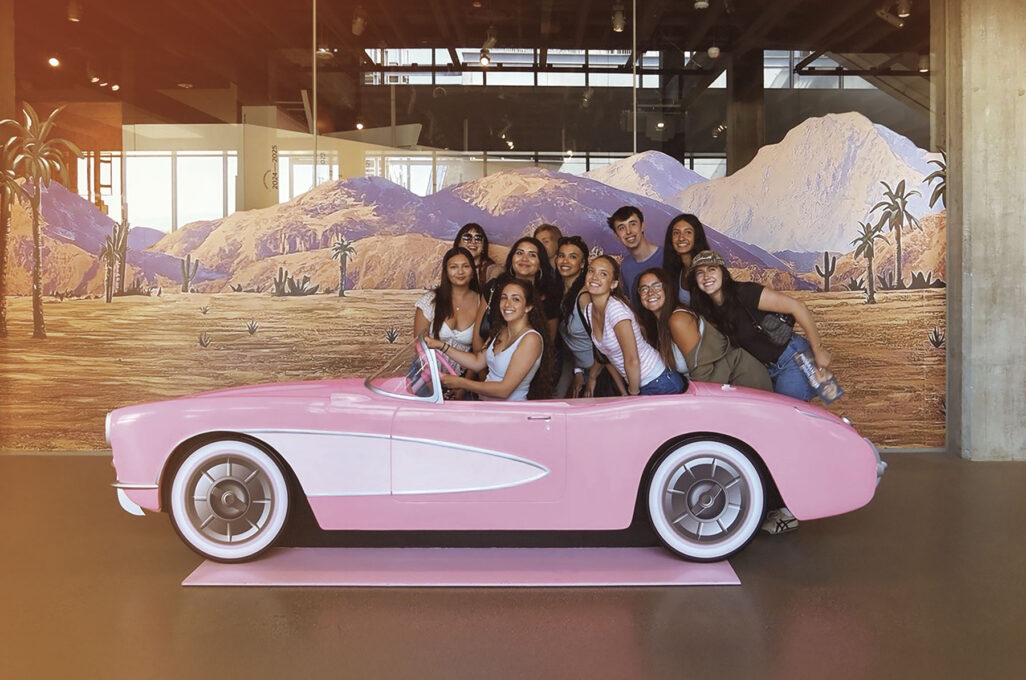
Like everyone else in the room, Evy Dhyanchand couldn’t believe what she was experiencing.
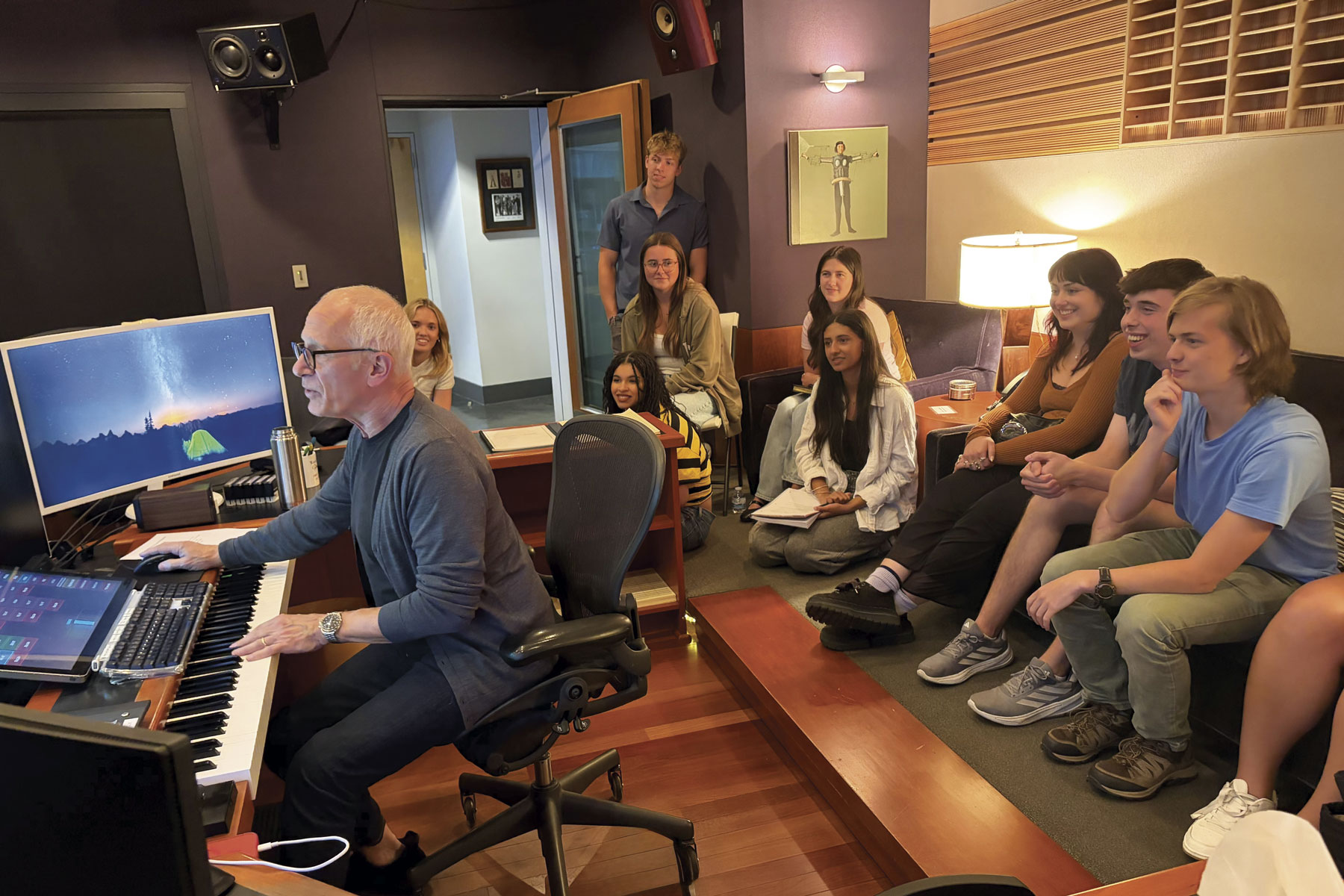
There she was, in the cozy Santa Monica studio of award-winning film composer James Newton Howard, an artist whose accomplishments include the musical scores of triple-A movies like The Hunger Games and Fantastic Beasts and Where to Find Them. He was playing the scores on his keyboard while sharing his composition process.
“I was starstruck the entire time we talked to him, but it was fascinating to see his process,” says Dhyanchand, a junior from Lancaster, Wisconsin, studying communication arts and music composition. “We had the chance to hear him explain the film composition process, from the conception of his own thematic ideas to the final discussions with the director.”
The afternoon in Howard’s studio was just one of a long list of jaw-dropping moments Dhyanchand and the 13 other students who were part of the inaugural Creative Careers in Hollywood (CCIH) program got to experience last summer. Conceived and constructed by Derek Johnson (MA’04, PhD’09), professor and chair of the Department of Communication Arts, and Jamie Prey (’12), the department’s alumni relations officer, CCIH brought the students to Tinseltown for three activity-packed weeks in June. After years of gestating as an idea, the program took the pair about 12 months to put together.
“I thought it could be valuable for our students to help connect them with alumni and other working professionals in the industry and give them a better understanding of how Hollywood works and what L.A. is like,” explains Johnson. “Because if they’re thinking about trying to make a career there someday, it’s going to be easier if they’ve actually encountered the place before.”
Several other institutions have created similar trips for students, but other institutions don’t have the engaged and expansive network of Hollywood-based alumni that UW–Madison’s Department of Communication Arts has. For instance, Prey was able to leverage the fact that film composer Howard’s agent is L&S grad Sam Schwartz (’72), which led to that impromptu studio session. On the second day of the program, the students attended a reception with a whopping 100 communication arts alumni and friends currently working in the entertainment industry in Hollywood.
The CCIH experience kicked off with a pitch panel. Each of the students was paired with an alumni mentor and expected to develop a pitch for a television show by the time the program was over. Zoë Littlefield, a current sophomore majoring in English and sociology, was paired with communication arts alumna Nikki Schiefelbein. Schiefelbein had worked her way up from being a showrunner assistant for “One Tree Hill” to becoming part of the show’s writing staff for six of its nine seasons, a gig she parlayed into bigger success, writing for shows like “The Umbrella Academy” and “The Ranch.”
It was really this wonderful snapshot of all Hollywood has to offer. That helped me not only get excited about the industry but also narrow down what I actually want to do.
Looking back on her own early-career experience, Schiefelbein recognizes that she wasted years trying to figure out her path in Hollywood. She believes the CCIH program could save the students from at least some of that inefficient anguish.
“For me it was really a goal to cut through some of that,” she says. “You don’t have to know exactly what you want to do when you come out here, but just to have an idea and to have the resource group of alumni saying, ‘Hey, yeah, maybe try that,’ or ‘Here’s a job opening if you’re interested in this.’ We’re more than just a network the students can tap into. We’re genuinely rooting for them. The students have cheerleaders in us. I think CCIH made that clear.”
Littlefield took immediate advantage, turning two of her connections with alumni members into summer internships. Her panel pitch was for a show she dubbed “Crack Heads,” an “Abbott Elementary” meets Waiting for Guffman workplace mockumentary about a dysfunctional ballet company performing The Nutcracker. Schiefelbein and the rest of the panel loved it, encouraging her budding interest in screenwriting.
“It was really this wonderful snapshot of all Hollywood has to offer,” Littlefield says of her time with CCIH. “That helped me not only get excited about the industry but also narrow down what I actually want to do.”
Carson Klamert, a junior majoring in communication arts and zoology, was paired with mentor Rachel Bozich (’14), a documentary filmmaker who’s done work with Netflix, Amazon Prime and HBO Max. Bozich gave Klamert keen advice on pitching, building and maintaining long-lasting connections in the industry. Better still, she also brought him on set for one of the documentaries she was filming.
“I don’t want it to sound cliché, but that was seriously a life-changing experience for me,” Klamert says. “The mentors were very nice and open to building a connection beyond the program and not just treating it as ‘I gotta talk to this kid for three weeks.’ They actually cared about our futures and our success.”
Thanks to Eric Bergman (’90), the students got to do hands-on work with a loop group at Warner Bros. Studio, recording post-production background dialogue to be used for a television scene. They did a table read with alumnus Brent Crowe (’97), a production manager with 20th Television Animation and one of the producers of “Family Guy.” Film director Sean Hanish (’90) had the students pretend to be actors, re-blocking scenes from the movie Moneyball, in order to teach them how directors get good performances from talent.
If they’re thinking about trying to make a career there someday, it’s going to be easier if they’ve actually encountered the place before.
“Some of the things that worked really well were the instances where our alumni and other industry professionals didn’t just talk to or with the students, but did stuff with them,” says Johnson. “Moments like that got the students to not just hear how these things work, but to actually do it and participate in it themselves.”
After hearing about the full scope of the students’ potential career interests, one of the alums who spoke to the group described them as a “mini studio,” spanning the gamut of career possibilities required to take an entertainment project from start to finish. And in a sense, they behaved that way. The 14 students spent most of their unprogrammed time working as a group, helping each other hone their panel pitches. On the trip’s final day, they visited the Universal Studios amusement park and never left each others’ sides.
“I thought about that mini studio idea a lot when I saw them working together, because they were always there to support one another,” says Johnson. “I think the strongest network they found might be the 14 of them.”