


To separate Wisconsin from its identity as a sports school would be to alter its DNA entirely. Competition bleeds into every corner of campus from Camp Randall and the Kohl Center to Union South watch parties and pickup games in the parks.
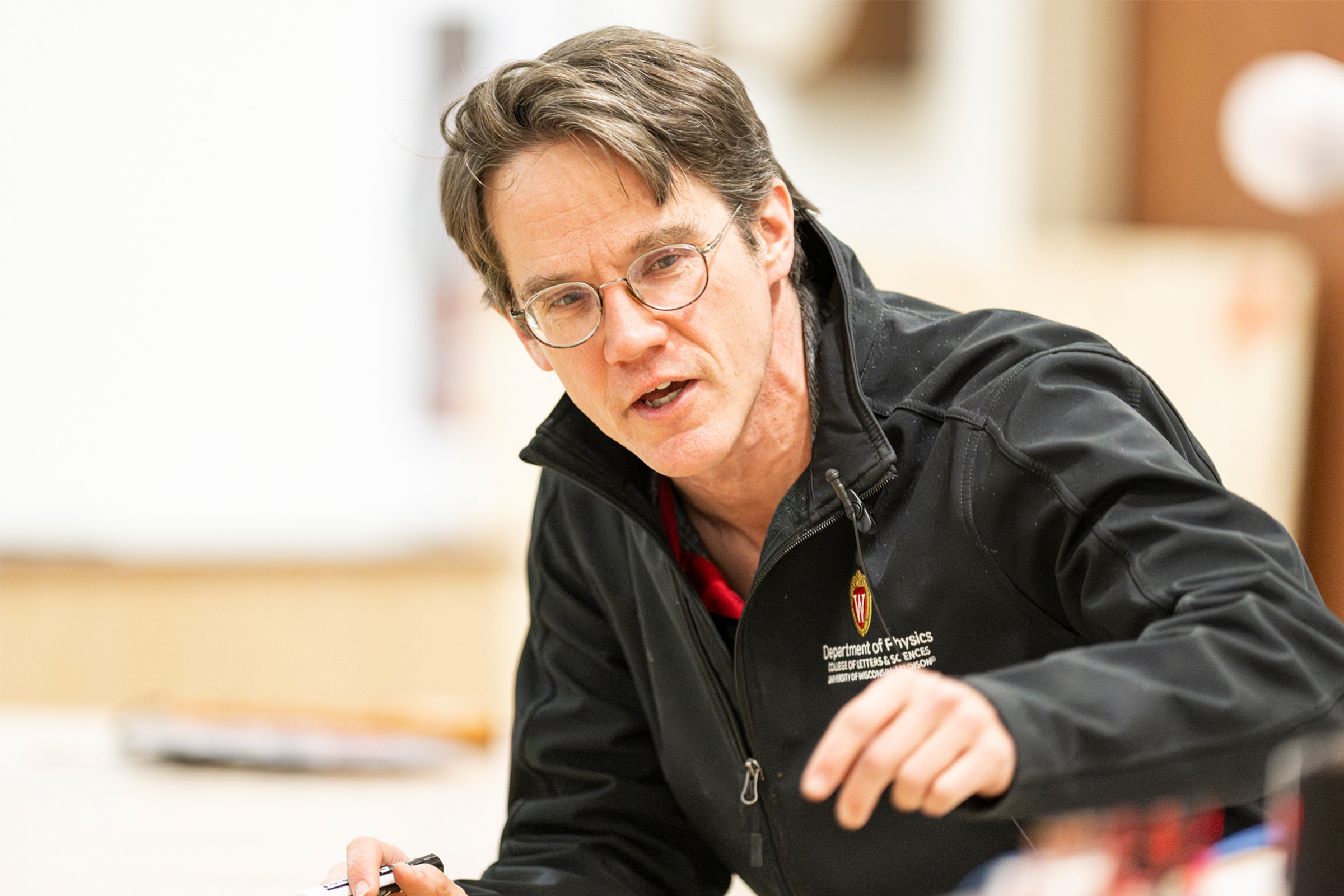
Now, the director of undergraduate studies and teaching faculty for the physics department, Jim Reardon, has tapped into this interest in a new way: through science.
His course, “Physics of Sports,” teaches students the principles of physics by applying them to competitive sports. Reardon developed the course in 2023 after learning about something similar being taught at the University of California, Irvine. This was the first time he built a course curriculum entirely from scratch. In his first semester teaching the course he had only four students, and one of them was auditing. Ultimately, the plasma physicist is grateful for the early low-stakes environment.
“You might be an expert tennis player, or you may watch it casually, or you may not even know of the existence of the sport,” says Reardon. “I needed to make materials that stood up from all three points of view.”
Knowing that UW–Madison is a sporty place, I thought this course would be a success.
Since that first lecture in the spring of 2023, the class has exploded in popularity. Enrollment numbers now sit at around 300 undergraduates. Reardon’s emphasis on inclusion means that it attracts everyone from dedicated physics majors to a wide variety of undergraduates looking for an interesting way to fulfill their prerequisites.
“Knowing that UW–Madison is a sporty place, I thought this course would be a success,” he says. “I thought unless I messed up really badly, there would be an interest.”
The nature of the course also allows for the personal interests of students and faculty to shape the curriculum. Reardon is involved with the Wisconsin Track Club and completed his graduate work at MIT, in marathon-crazed Boston. His personal affinity for running is incorporated into the coursework. When he had a teaching assistant with an interest in sailing, they worked together to create lessons on how boats sail upwind and other sailing physics topics.
Another one of Reardon’s favorite lessons to teach looks at aerobic metabolism in athletes by comparing a human to a fire tornado. A fire tornado that suddenly burns 10 times brighter is comparable to an athlete who is suddenly in motion. Reardon, easily characterized by his readiness to learn from both scientists and athletes, believes that within every sport is a different lesson.
“U.S. Olympian Breezy Johnson was quoted as saying that going on a downhill ski run in the Olympics is like solving physics problems at 80 miles an hour,” Reardon says. “There’s clearly something we can learn by studying any elite athlete in any sport.”
Forces at Work
Jim Reardon explains the forces in play for Wisconsin Badgers forward and defender Laila Edwards (’26) during the team’s winning NCAA Division One Women’s Hockey National Championship game.
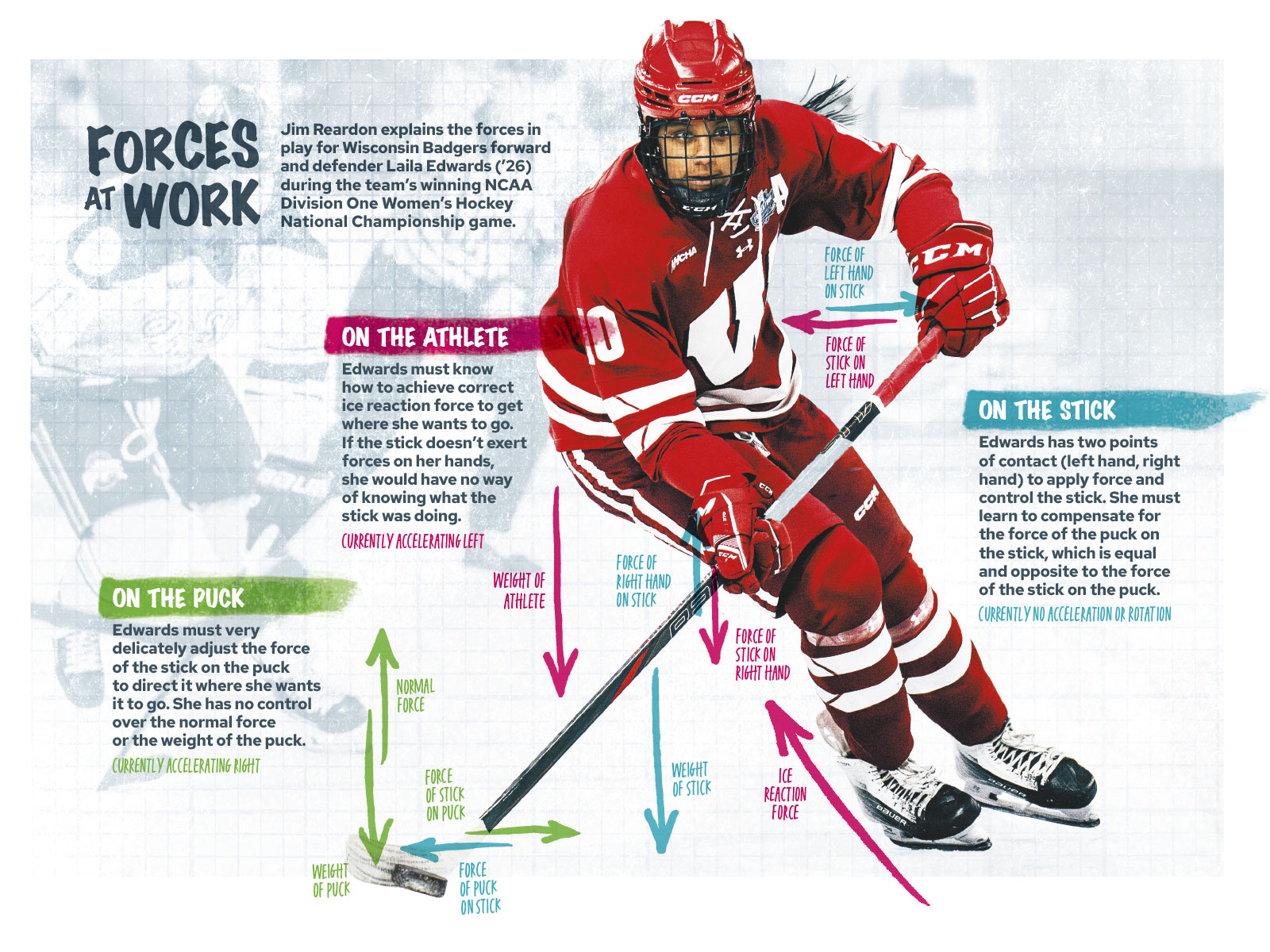
On the Puck: Edwards must very delicately adjust the force of the stick on the puck to direct it where she wants it to go. She has no control over the normal force or the weight of the puck. Currently accelerating right
On the Athlete: Edwards must know how to achieve correct ice reaction force to get where she wants to go. If the stick doesn’t exert forces on her hands, she would have no way of knowing what the stick was doing. Currently accelerating left
On the Stick: Edwards has two points of contact (left hand, right hand) to apply force and control the stick. She must learn to compensate for the force of the puck on the stick, which is equal and opposite to the force of the stick on the puck. Currently no acceleration or rotation