
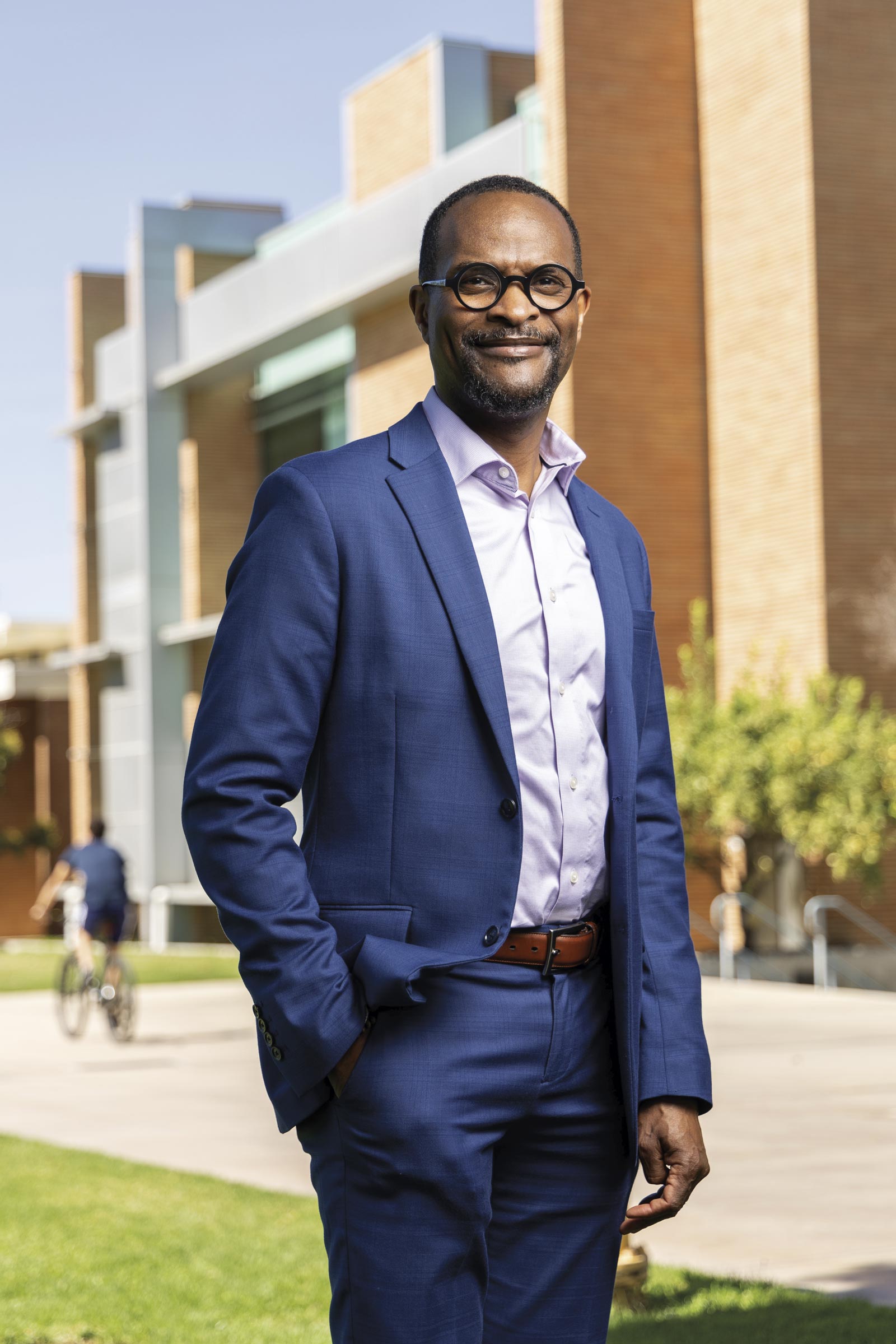
For Mario Sims (MS’93, PhD’97), the path to public health didn’t begin in a laboratory or a clinic, but in the neighborhoods that shaped his earliest questions about place and wellness. Born in Compton, California, and raised in a lower-middle-income community, Sims was drawn to understanding how the social forces embedded within his neighborhood shaped people’s lives and health outcomes.
The types of questions Sims asked as a youth have a long history, including the landmark study of Black life, health and inequality published by W. E. B. Du Bois in 1899, The Philadelphia Negro. Sims first encountered Du Bois’ work in high school and was immediately drawn to the types of probing questions Du Bois asked more than a century ago. Du Bois’ work investigated how neighborhood conditions influence outcomes, questions that felt deeply personal to Sims.
“This comprehensive study motivated me to want to study the community I’m from,” says Sims.
Sims, a distinguished professor and graduate faculty director of the Master of Public Health program at the University of California Riverside School of Medicine, has seen his career unfold at the intersection of sociology, medicine and public health. But a single principle has guided his work throughout: Meaningful progress on health equity requires communities to be partners in the science, not subjects of it.
Sims came to the University of Wisconsin–Madison to pursue a PhD in sociology, focusing on medical sociology and demography, which looks at population health. Working alongside late preeminent scholar Franklin Wilson, most recently the William H. Sewell-Bascom Emeritus Professor of Sociology, Sims studied how neighborhood location influenced health and socioeconomic outcomes across five metropolitan areas. The work reinforced a core insight that would follow him throughout his career.
“The description of your neighborhood — whether it is poor or affluent — shapes what your social and economic outcomes are likely going to be growing up in these types of environments,” Sims says.
Sims’ curiosity about how social questions impact medical outcomes would find its fullest expression when he was recruited to the Jackson Heart Study, the largest and most comprehensive study of cardiovascular disease among Black Americans. Based at the University of Mississippi Medical Center and funded by the National Heart, Lung, and Blood Institute (NHLBI) and National Institute on Minority Health and Health Disparities (NIMHD) of the National Institutes of Health (NIH), the Jackson Heart Study has followed more than 5,300 participants since 1999 to better understand the causes and consequences of heart disease. When Sims arrived, the term social epidemiologist had not yet been widely used.
“They started calling me a social epidemiologist,” he says. “I said, ‘Well, I’m a sociologist who’s interested in health from a medical standpoint.’”
With the Jackson Heart Study, his work focused on how stress, discrimination, neighborhood conditions and other social and psychosocial factors contribute to cardiovascular disease disparities. From the outset, community partnership was essential to the study’s success. Given the long history of medical exploitation and distrust within underrepresented communities, researchers knew that participation could not be taken for granted.
“Contrary to people’s thoughts about hesitancy, community members came out,” Sims says. “It’s because we developed relationships, which took time, and included participants at the table of decision making.”
Community members were not treated as secondary partners, but as collaborators. That approach built trust and momentum. Sims would remind participants that the study had their best interests at heart, and the fact that it was run by scholars who lived in their community and looked like them encouraged participation.
Churches, fraternities, sororities, nonprofits and local organizations became vital partners, helping the study take root and grow. That community connection also reshaped the science itself. Sims recalls participants asking researchers to move beyond deficit-focused narratives.
“They were saying, ‘We know that death follows stress and discrimination, tell us something good. Tell us something positive.’”
It’s because we developed relationships, which took time, and included participants at the table of decision making.
That feedback pushed Sims to study not only risk, but resilience — optimism, positive outlook and health-promoting behaviors that might buffer the effects of stress and discrimination. Over time, Sims rose to leadership roles within the Jackson Heart Study, eventually serving as chief science officer, interim director, principal investigator and chair of its steering committee. His work also had impact nationally. As chair of the American Heart Association’s social determinants subcommittee, he helped lead a 2020 presidential advisory on structural racism and cardiovascular disease.
The report framed structural racism as a public health problem and a fundamental driver of health disparities and health inequities. In recognition of this and other scientific contributions in the field of cardiovascular epidemiology, Sims was elected to the National Academy of Medicine in 2022, an honor he attributes largely to his work in Jackson. In 2023 Sims was the recipient of the Inaugural Devah Pager Distinguished Alumni of the Year Award by the UW–Madison Sociology Department Board of Visitors.
After nearly two decades, Sims felt ready to build something new. He returned to California where he helped to launch a master’s program in public health. He is also laying the groundwork for a new, multiethnic cohort study in Inland Southern California, one that builds on the Jackson Heart Study model while reflecting the region’s diversity. Despite funding challenges and shifting political climates, Sims remains hopeful. After years of studying the impact of social determinants on cardiovascular disease inequities, his current work increasingly highlights the power of positive psychosocial factors on cardiovascular health.
“We’re starting to show that the positive side of things can help mitigate some of the negative,” he says. “Optimism, healthy behaviors and supportive environments can promote cardiovascular health, longevity and healthy aging.”
For Sims, the lesson remains clear: Meaningful public health research begins — and succeeds — with the community involved.
“When you bring people to the table as true partners, they take ownership,” Sims says. “And that’s what makes this kind of work last.”