

An Ethical Dilemma
Your time is their money. Here’s how a philosopher grapples with the ethics of the attention economy.
The birds are chirping, the sun is rising, and it’s time to wake up. What’s the first thing you reach for? Maybe it’s a glass of water or an old-school alarm clock, but if you’re an American, statistically it’s most likely that you’re grabbing for a phone. It might start with silencing a morning wake-up call, but this habit opens you up to checking your email, scrolling through social media or reading the news.
This is how many corporations are making their profits. Because as you’re checking your feeds, they’re sneaking in ads while simultaneously collecting a bankable asset — your data. Welcome to the contemporary attention economy, where your individual time is the valuable product bought and sold to fuel the world’s economic engine.
“We’ve made a cultural choice to invite these devices into all kinds of contexts,” says Clinton Castro (MA’14, PhD’18), a philosophy alumnus and current assistant professor for the Information School and affiliate faculty member of the Department of Philosophy. “As a bike commuter, I often have uncomfortably close calls with a car because someone is on their phone. Think about the bizarre circumstances that have normalized this kind of behavior — even if we all know it’s bad to be on your phone while driving.”
Kant encourages us to understand which things are important to us and why, and then make a wise choice in the face of those considerations
In writing his 2024 book Kantian Ethics and the Attention Economy, Castro notes that the attention economy is nothing new. He traces it back to the 1830s when The New York Sun started subsidizing the cost of a newspaper with advertising that targeted their massive audience. What is new are tactics like aggressive data collection, addictive algorithmic curation and advanced micro-targeted advertising, all used by big tech companies.
There are a lot of ways to approach the personal and ethical pitfalls of the attention economy — constant distraction, screen overexposure, body image issues, mental health concerns, rapid polarization. For Castro, these concerns are united and given moral weight by Immanuel Kant’s views on the importance of autonomy, loosely defined as the ability to set and pursue your own goals.
When social media and smart phones are required to get through day-to-day life, your autonomy is at risk because these technologies can degrade key capabilities and promote inauthenticity.
“Last year I tried to go apple picking, and the orchard I found required me to download their app to see the map and varieties,” Castro says. “This is a testament to how embedded we are with this technology — I couldn’t even go apple picking without my phone.”
The Kantian core of what he studies exposes the ways the attention economy forces us to cede the authorship of our own lives to entities that are only interested in our time for the money. To change this would require sweeping societal shifts, including government protections. Castro advocates for this, especially in the case of children, who he fears are falling into a “collective trap.”
But as people wait for high-level change, there are some means of individual escape. Castro himself has no social media and bought an annoyingly small and slow phone to curb his screen appetite, though he still checks a necessary email account for work. At the end of the day, it’s up to the individual to decide how their priorities inform their level of engagement in the parts of the attention economy within their control.
“Kant encourages us to understand which things are important to us and why, and then make a wise choice in the face of those considerations,” Castro says. “And that’s appropriate advice, when talking about autonomy.”
Have a Word
A quick guide to the language of the attention economy
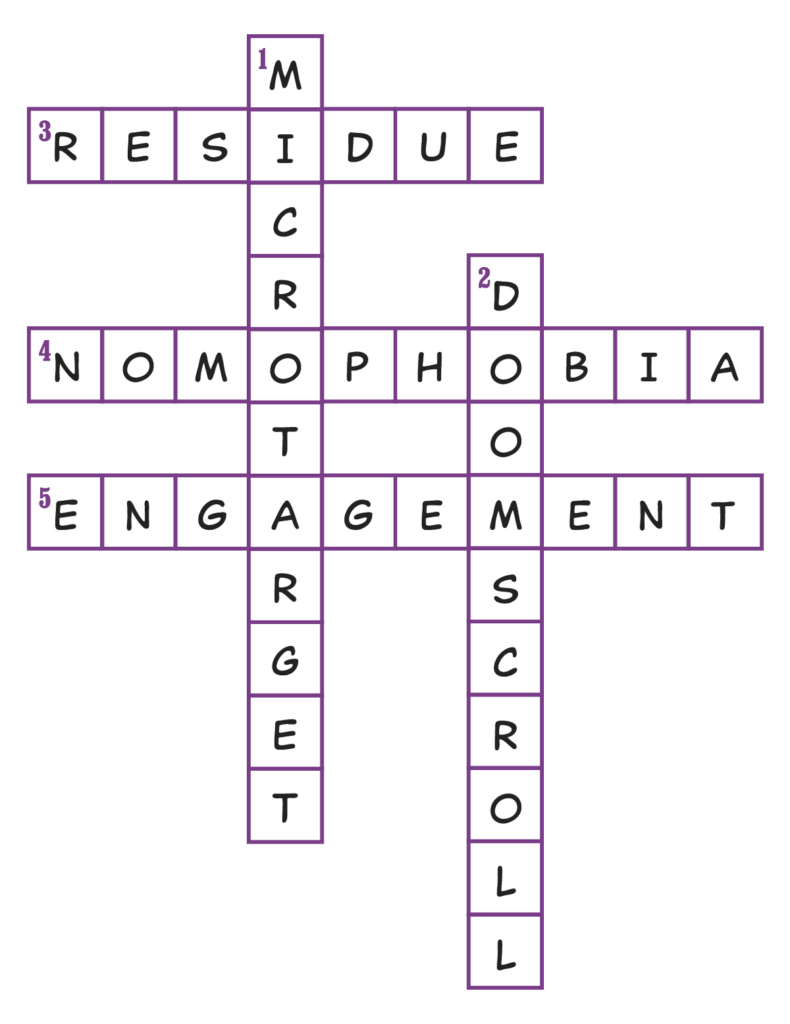
Down
1 The use of user data to show personalized ads
2 Compulsive scrolling through worrying content on social media or news sites
Across
3 Attention _____________: cognitive drag caused by switching between tasks
4 A new kind of anxiety over not having access to a mobile phone or cell service
5 Metrics used to measure and sell attention
Chat, Are We Cooked?
A psychologist addresses claims that our attention spans are shrinking.
C. Shawn Green’s first big break as a psychologist started with an unexpected discovery in the ’90s: People who play fast-paced action video games saw growth in their perception, attention and cognition. As the Mark and Ilene Laufman Family Professor and Chairperson for the Department of Psychology, he has continued to study the way different stimulants impact cognitive learning and neuroplasticity. Here’s what he has to say about smart phones, social media, constant connectivity and more ways technology is affecting our brains.

Have you heard that the average American attention span is shorter than a goldfish?
This one always makes me laugh, because (A) No, it’s not, and (B) I don’t even know how you would measure the attention span of a goldfish. But people have these concerns, and that happens pretty much any time there’s a change in the media landscape — we get this big swath of technophobia. Often when people are talking about shrinking attention spans, they bring up that dwell time on websites has gone down. But I don’t think that means people are incapable of staying on websites longer, it means that they are becoming really good at deciding what they want to devote their attention to.
How is modern technology impacting our ability to learn and focus?
Modern technology is putting pressure on our capacity to process information quickly and simultaneously, especially in cases of media multitasking. When I’m sitting at my desk, there are six different things that can ping me at once. This stresses those systems and forces me to get better at them and be adaptive to the environment I’m in. In general, people are good at learning new skills, so when there is an environment that requires them to exercise those skills, they improve.
If someone is feeling their attention span challenged, what can they do?
Think of your attention span as a pie: You have a certain amount of attention that you can devote, and anything that takes away from that means there’s less for you to access. So, for example, if you feel a phantom pocket ring [when you feel your phone vibrating, but there’s no notification], that means you’re devoting some amount of attention to where you keep your phone, and that is attention you can’t access for other tasks, like reading a textbook or listening to an instructor. Distractions like these are consistently problematic, but what counts as distractions for people can differ. You have to know yourself and what types of things allow you to focus or take away from your attention.
Brick by Brick
These entrepreneurial alumni designed a solution to our doomscrolling problem.
TJ Driver (’22) was done with his smart phone. He was grieving the free time he lost to Instagram and frustrated with how easily he could override app blockers. The solution? He thought it could be a flip phone.
“I looked into it, and it was so impractical,” says Driver, who’s a Wisconsin School of Business alumnus with a certificate in computer sciences. “I was living in Chicago at the time, and I couldn’t be in the city with a flip phone. I needed to take the train and get Ubers. Plus, I’d have to pay for two phone plans.”
He aired out these frustrations regularly to fellow Badger Zach Nasgowitz (’21) during their many business brainstorms. The pair had caught the entrepreneurial bug when they were undergrads at UW–Madison, taking advantage of programs like Discovery to Product (D2P) to learn the trade. After graduation, they hoped to start a business together.
We were following the conventional advice to look inward at our own lives and try to find a problem that we could solve. The thing that kept coming up as a big one was our phones.
“We were following the conventional advice to look inward at our own lives and try to find a problem that we could solve,” says Nasgowitz, an L&S grad who majored in economics with a certificate in computer sciences. “The thing that kept coming up as a big one was our phones.”
This time they built a working solution: Brick. The product they designed is a physical device roughly the size of a pack of sticky notes with a magnetic back to fasten to your fridge, laundry machine or another inconvenient spot in your home. Users tap their phone to it to block distracting apps, websites and notifications. Everything is handled through an app, which is customizable so that users can control what they consider a distraction. But once you’ve tapped your Brick, you have to be near the device to tap out and free your phone. So if you left it behind to grab coffee with a friend or do work at the library, you’ll have to wait until you get home to scroll TikTok. But even if you just leave it in another room, the physical need to get up and walk to the kitchen works as a stronger deterrent than switching off “Do Not Disturb” mode.
There are these trillion-dollar companies that have thousands of engineers and the smartest PhD behavioral scientists, and their entire goal is to maximize the amount of attention they can take from you. What would it look like to be the opposite of that?
“It’s important that people realize that we are not anti-tech,” Driver says. “Yes, our devices are constantly vying for our attention in bad ways, but we can also use them in positive ways. I can read any book ever written with this thing in my pocket. I can FaceTime with any person I’ve ever met at any time. There are things that we certainly want to overcome, but the exciting part is that the same devices that steal our attention also give us opportunities to use them in immensely positive ways, and that’s what we’re trying to push for with Brick.”
They had 1,000 signups before the product even hit the market, and today they’re racking up a loyal following, including celebrities Lorde and Stephen Colbert. And now they’re looking to the future to see how their startup can continue to support people in their fight to reclaim their time.
“There are these trillion-dollar companies that have thousands of engineers and the smartest PhD behavioral scientists, and their entire goal is to maximize the amount of attention they can take from you,” Nasgowitz says. “What would it look like to be the opposite of that? Hopefully someday we’ll have engineers and scientists, too, but our goal will be to maximize the time you spend on what matters to you.”
School of Thought
A psychologist addresses claims that our attention spans are shrinking.
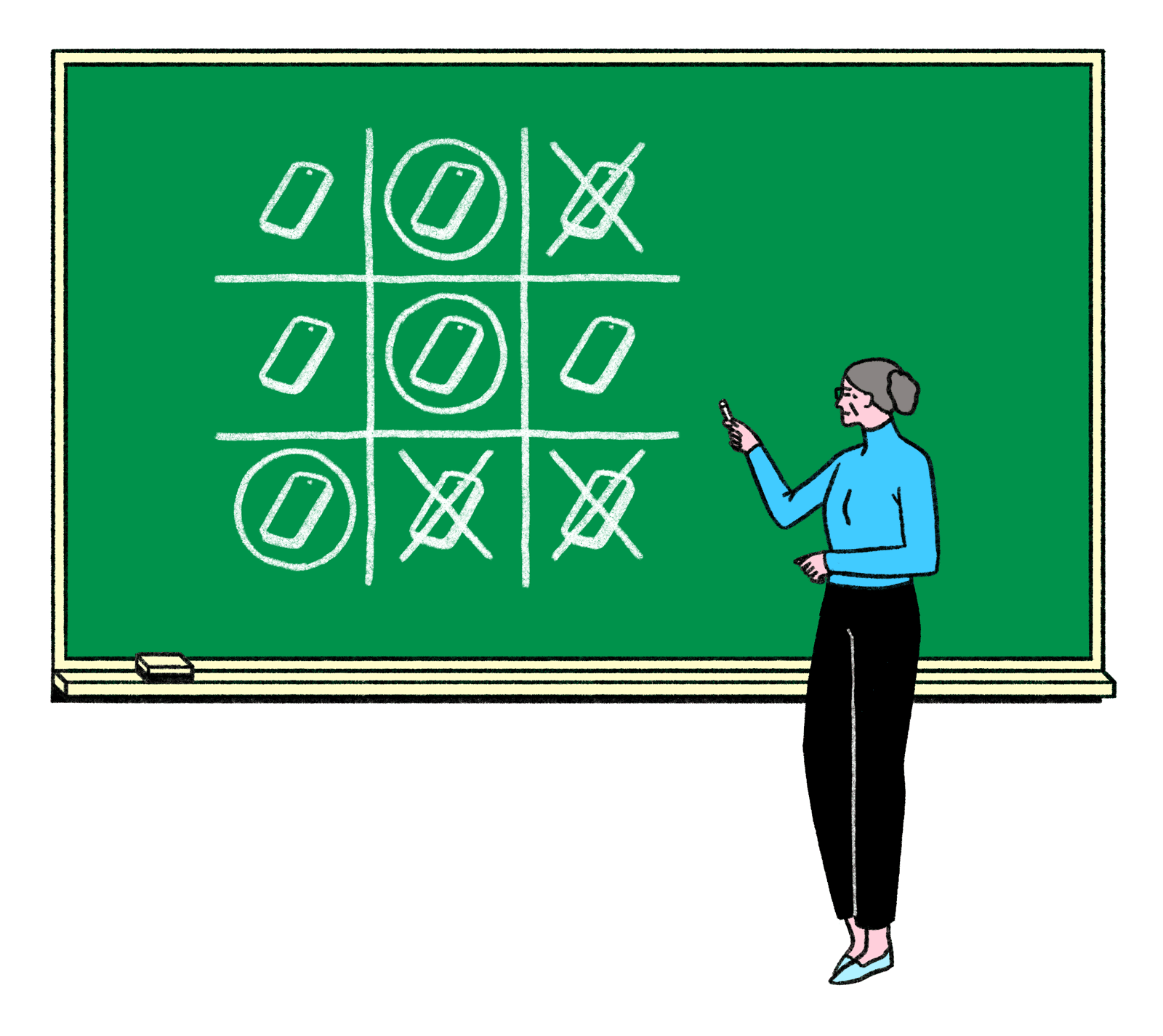
Late last year, Wisconsin Gov. Tony Evers (’73, MS’76, PhD’86) signed a law requiring all the state’s public schools to create a phone ban policy by July 1, 2026. He left the specifics of the bans up to the individual districts, and the Madison Metropolitan School District (MMSD) is tapping UW–Madison researchers for help creating an equitable, law-compliant policy that supports teaching and learning. Grace Skiba, a graduate student in the La Follette School of Public Affairs, is on the team that will make a recommendation to the district. Here are three factors researchers are considering as they develop a policy.
The Teachers
Without a district-wide policy, the burden of managing phone use in class currently lands on the teachers. That’s why the research team is interviewing administrators and teachers to get their perspectives. Consistently they’ve heard gripes about class disruption not only from phone usage, but from the time taken to discipline it. “That puts a lot of pressure on teachers,” Skiba says. “And depending on what kind of teacher you are, there’s a wide range of how much you want to discipline your students about phones.”
The Students
School is meant to provide students with the skills they need for life, and one of the skills the district has expressed interest in teaching is how to use phones in responsible ways. Some students are looking for better strategies to regain focus in class. “Some students who answered the district survey felt they might be able to focus better in class if phone use was limited,” Skiba says.
The Practice
Other districts around the country have developed their own policies, and UW–Madison researchers have the benefit of reviewing what does (and doesn’t) work. They’ll look at new technology that has been developed to solve this problem, but they’ll also factor in whether the technology is cost effective and easy to implement. “This is going to affect a lot of people, and phones are a sensitive topic,” Skiba says. “Policy recommendations are really only worthwhile if they are feasible.”
The report is now available to read in full, and the district has already put many of the recommendations into practice.
24 Hours Without Media
This journalism class requires a digital detox.
 Could you go a full day with no phone, no internet, no TV? That’s the challenge Hernando Rojas, the Helen Firstbrook Franklin Professor of Journalism, assigns to students in his “Introduction to Mass Communication” course. He has been giving the assignment for almost a decade, and students describe it as life-changing. Even though they take the challenge seriously, most don’t make it more than five hours — but don’t worry, they don’t flunk. The grade comes from a first-person reflection of the experience, answering when it got hard, why they did or didn’t give up, and whether they feel dependent on technology. “Even for students who don’t make it, I think knowing you aren’t able to resist technology for 24 hours is a lesson in and of itself,” Rojas says, adding that you don’t have to be a student to try the challenge.