


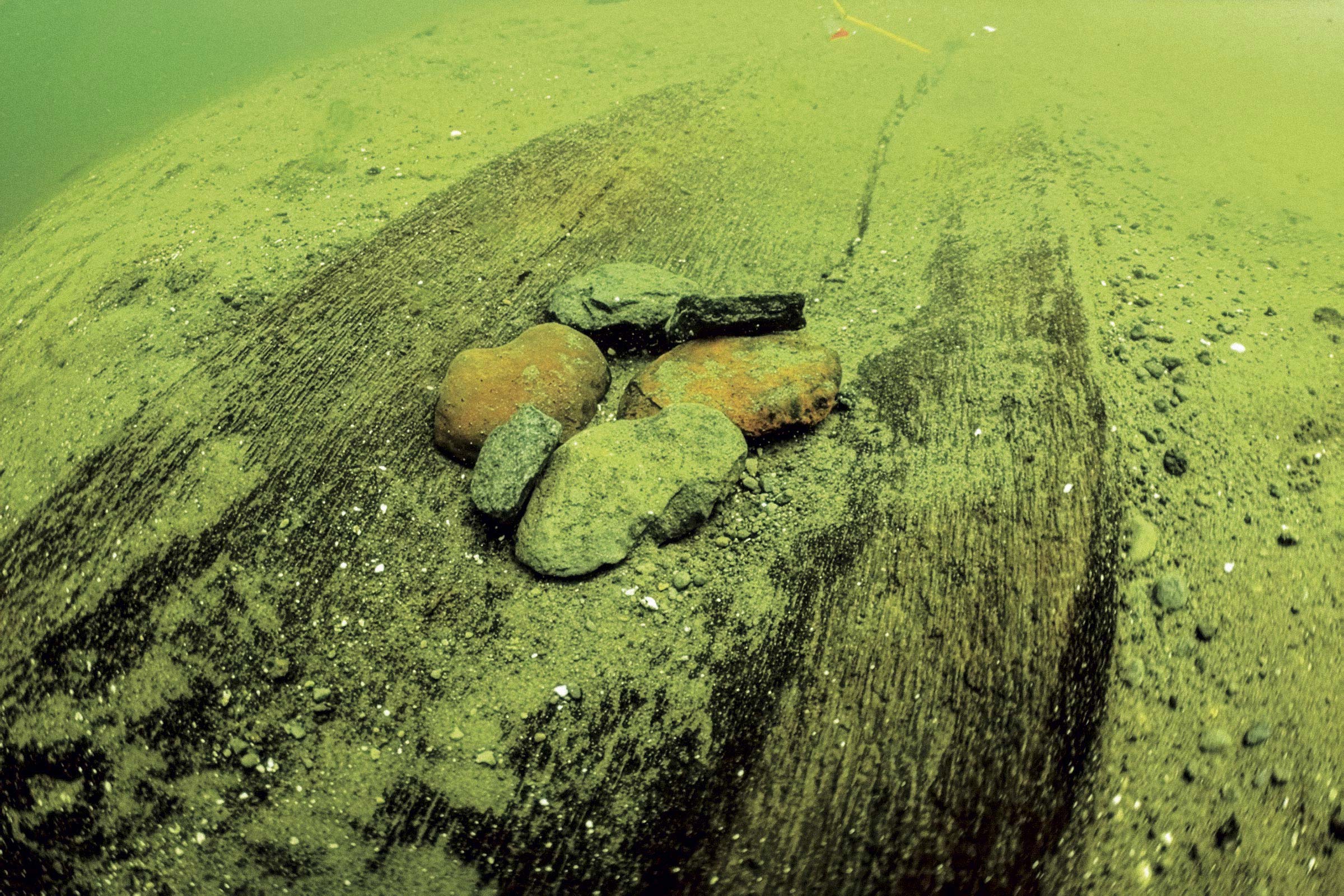
A hollowed hunk of canoe made from elm, oak or some other type of wood found lodged in the Lake Mendota shoreline. A direct piece of history embedded in Madison’s very own urban waterways. A shared transportation network, centuries-old: an ancient BCycle, if you will.
Dugout canoes are the world’s oldest boat type, constructed by hollowing out a massive tree trunk and traditionally used by Indigenous populations. They’re the centerpiece of the Wisconsin Dugout Canoe Survey Project, a collaborative effort with archaeology experts, tribal historic preservation officers, historical societies and more.
The project started back in 2018 with Ryan Smazal (’19), at the time an undergrad studying history and political science, and Tamara Thomsen (’91, MS’93), an alumna from the College of Agricultural & Life Sciences and maritime archaeologist with the Wisconsin Historical Society. Smazal had a research-minded affinity for underwater archaeology, and Thomsen suggested he research and document dugout canoes across the state. By sheer coincidence, three years later, Thomsen was on a recreational dive with a serendipitous safety stop when she spotted a bowed nub poking out of the sediment.
“That was the first of the Lake Mendota dugouts that was found,” says Sissel Schroeder, Smazal’s thesis advisor and a professor of anthropology as well as the Bradshaw Knight Professor of Environmental Humanities in the Nelson Institute for Environmental Studies. “It was radiocarbon dated to 1,200 years ago, and the Historical Society mounted the effort to raise it and then do the conservation work.”
It was a way of sharing the water transportation method with the community. The concept of ownership didn’t exist — they were available for people to use when they needed it.
It soon became clear that the pieces brought up were different colors, densities and textures. That meant the remains were not from only one vessel. They represented other dugouts concealed in the Mendota shoreline.
“The dugouts being revealed are of great interest to us, as they serve to support our oral history of our Indigenous connections to the Dejope [Four Lakes] region,” says Bill Quackenbush, tribal historic preservation officer for the Ho-Chunk Nation of Wisconsin. “Our ancestral connection to these four lakes reaches as far back as the last glacial episode.”
The 16 dugouts that have now been discovered — the oldest of which dates back more than 5,000 years — are in three different clusters near the Shorewood Hills Marina. Each cluster is directly in front of a gully through a bluff, offering an alternative passageway for travelers to the sheer rock face.
“We are getting some new information about traditional ecological knowledge and technological innovation,” says Schroeder, explaining that canoes weren’t just abandoned randomly. They were deliberately sunk and stored at specific access points. “Those locations where the dugouts are clustered were like nodes of transportation. It was a way of sharing the water transportation method with the community. The concept of ownership didn’t exist — they were available for people to use when they needed it.”
The BCycle analogy is one that Schroeder and Thomsen have regularly referenced. Much like the bike racks scattered around campus, every canoe was fair game for any mobile endeavors.
“One of the things that’s been really fascinating about dugout canoes is that they’re easy for us to envision,” Schroeder says. “Many of the artifacts that we find as archeologists are broken pieces, making something very difficult to visualize. It creates this extra distance between people and ancient material culture. But canoes are easy for people to recognize what the object is and how it was used, and maybe even imagine themselves in the water in a dugout canoe.”